Showing posts with label Penny Fussell. Show all posts

Sunday, 27 February 2011

THE VARDON NELSON FUNERAL SCROLL: QUERIES AND CLARIFICATIONS

My post on the Vardon scroll depicting Nelson's Funeral procession to St Paul's in 1806 (see post of 25 January) has generated quite a lot of interest and some further reflection as to what it exactly might be.  The website Nelson and His World - http://www.nelsonandhisworld.co.uk/ - picked up the debate very quickly. 

There was some reluctance in the Nelson and His World discussion thread to accept that a ten year could have been sufficiently competent to do the work.  I have no doubt that John Vardon was.  I have a passing interest in English drawings and watercolours of this period and the execution of the scroll is well within the competence of as ten year old at the time.  Training was much more focused, high standards were expected and, quite frankly, a world with fewer distractions meant that work was done much more thoroughly.

Also doubt was cast about the genuineness of the lump of fossilised soup that the Vardons stated to have been preserved from a batch prepared on HMS Victory on 21 October 1805.  As it has now completely disappeared, I think the odds are long that it has survived at Buckingham Palace or some other royal palace, we will never know with certainty.  All I was doing as a blogger was to report a family tradition.  It is one I find quite credible.  There was an immediately reverential interest in anything connected with the Battle of Trafalgar as soon as it was clear what a great victory had been achieved linked to the poignant fact that Nelson had been killed in the hour of his greatest triumph.  Preserving a lump of soup in such circumstances seems quite understandable.  What is of greater interest is quite it lasted so long without modern methods of preservation such as freezing or rapid dehydration.
The Toy Lord Nelson Funeral Panorama.  Thin paper sheet 12x7.5 inches. Published 25 January 1805 priced at one shiiling and sixpence.  The sheet would have been cut up and the procession glued together as a roll.  It would then be drawn across the scene on the bottom left to animate it.  Sold for £920.  With acknowledgements to the 1805 Club.
The remaining area of debate has been the influences on, and possible purpose of, the scroll. Penny Fussell, our archivist, has I think found the complete answer. The Kedge Anchor, the newsletter of the 1805 Club has a useful section reviewing sales of naval memorabilia.  In the March/April 2010 edition - number 27 - there is the record of a toy Lord Nelson Funeral Panorama sold on eBay by a seller in Bristol.  It is almost certainly the inspiration of Paul Vardon's home-made copy.

I can remember playing with similar paper cut-outs drawn across a small cardboard box proscenium stage.  They were often processions of circus animals. There was also a variation where cut outs were passed in front of a light source to create a shadow show.

Incidentally the 1805 Club was founded in 1990 to care for the memorials of the Georgian sailing navy.  For more details go to http://www.1805club.org/

Wednesday, 8 December 2010

LORD MAYOR'S CHRISTMAS TREE: A JOB FOR THE FIFTH WARDEN

Our fifth warden?  The Drapers' Bear about to depart from the Hall in full regalia to do duty in the Mansion House for the rest of the mayoral year.  I will try and not fall victim to Ruskin's 'pathetic fallacy' that humans project their own emotions onto animals or, even worse, fluffy little representations of animals.  Nevertheless he looks a little despondent, either because he is leaving the Hall or because of the huge weight of representational responsibility that now lies on his narrow and furry shoulders.
Photograph thanks to Penny Fussell 
Each year the Lord Mayor and Sheriffs choose charities.  This year they are Coram the children's charity, see www.coram.org.uk/  and RedR the international disaster and humanitarian relief group, see  www.redr.org.uk/

As part of the fund raising effort the Lord Mayor, Michael Bear, is pursuing a bear theme throughout the year.  Part of this is a Christmas tree in the Mansion House that will be decorated with furry little teddy bears.  Each bear will have a sponsor and all 108 livery companies have been invited to participate. 

We decided that the basic red jumper bearing the title Drapers' Bear did not do full justice to the Company and, anyway, red is not a Company colour.  Penny Fussell therefore made a beautiful set of warden's clothing, including hat, for him to wear.  The result is that we now have a 'fifth warden.'

Once the Christmas Tree is taken down the bears will spend the rest of the year in the Lord Mayor's office before being returned to their owners.

Sunday, 28 November 2010

ROYAL COLLEGE OF DEFENCE STUDIES VISIT: 19 NOVEMBER


The Royal College of Defence Studies is located in Seaford House on the south-east corner of Belgrave Square. 
The Royal College of Defence Studies has, since 1922, provided training for senior officers and officials both from United Kingdom and other countries and future leaders from the private and public sectors for high responsibilities in their respective organisations.  Its mission statement promises to develop analytical powers as well as widening  knowledge of defence and international security.  More details are at www.mod.uk/rcds

Meeting up before lunch in the Drawing Room
I am not entirely sure I measured up to these very high aspirations.  Nevertheless, I attended the Royal College of Defence Studies in Belgrave Square in 1995.   Alastair Ross, the Clerk, also attended as a naval officer a few years earlier.

Most years my course meets up for a reunion and, because each course includes representatives from at least twenty-five countries, they are held world-wide including Australia, South Africa and the Czech Republic. This year, the fifteenth anniversary of our course, the reunion was back in London.

As part of the series of events in this year's programme we met at the Hall on Friday.  A good number turned up and after a buffet lunch we toured the Hall.  As usual Penny Fussell gave her excellent talk that she seems to to tailor effortlessly to each group of visitors.

The Master's jewel about half size.

I began the visit by wearing my Master's badge which is an impressive jewel containing 365 diamonds, one for each day of the Master's year.  One of the less respectable members of my course suggested on a leap year the 366th should be worn as a nose stud.  I think this idea has little chance of adoption by what I have absolutely no doubt, as far as the male members are concerned, is an unpierced Court.

In the Company's strong room.


Planning now starts for the sixteenth reunion.

Tuesday, 5 October 2010

DRAPERS' ACADEMY: YEAR 7 VISIT TO THE HALL 1 OCTOBER

Friday saw the first visit of a Drapers' Academy year group to the Hall.  This takes up a custom that most of the Drapers' schools, particularly those closer to London, arrange an annual visit for their entry year class to see the Hall and learn something about the Company's history, traditions and current work.

As many will recall Friday was a particularly wet day and the Drapers' Academy visitors got a little disorientated in the maze of alleys that surround the Hall.  Eventally a bedtraggled, but still remarkably cheerful bunch of eleven year olds, led by Mr Cormac Fanning, Assistant Vice Principal in charge of Year 7s (11 to 12 year olds who are just starting off in the Academy), entered the Hall having toured Copthall Avenue, Throgmorton Avenue - a near miss- Austin Friars and Old Broad Street.


I am the only one not waving and not sure why!  Lunch in the Court Dining Room.
Photgraph by Penny Fussell
They were met by me in full regalia and quickly ushered upstairs to the Court Dining Room for a fish and chip lunch.  Alastair Ross, the Clerk and Penny Fussell, the Archivist, also acted as hosts.

As I have mentioned before, see my post on London Open House of 23 September, it is all too easy for those of us involved with the Hall on a day to day basis and aware of the maintenance tasks and so on, to lose sight of the fact that it is a magnificent building.  The Year 7's were a great bunch of enthusiatic eleven year olds and there was a torrent of questions. 

'Did I have to pay to keep the Hall going?' - fortunately not.

'How much did the chandeliers - Pavlenko's portrait of HM the Queen - and many other things in the room - cost?'  - I havev to admit to have made up a few sums based on the formula 'a lot.'

Was the portrait of Sir Ernest Pooley me?'  - He may be distinguished but I hope I do not look quite as old.

The fish and chips provided by Jon Perkins, and his team went down extremely well and the prospect of tables getting extra portions of chips in turn was very popular.

The meal ended and Penny Fussell showed the children round the Hall then it was back on the coaches waiting at London Wall and back to Harold Hill.  It was a great day and during the rest of the term Years 8 to 11 will also pay a visit.  It was the start of a great tradition.

Drapers' Academy year 7s heading off up Throgmorton Avenue and through the Drapers' gates to meet the coach at London Wall.  It is raining and the new Drapers' Gardens block looks most attractive with its pallette of greys that works very well in London.
Photograph by Penny Fussell

Wednesday, 29 September 2010

REHANGING OF PORTRAIT OF SIR ROBERT CLAYTON 22 SEPTEMBER

The portrait of Sir Robert Clayton before cleaning.  He is now looks much cleaner and slightly less bilious.  The details of the sword and curiously shaped white fur hat on the table are also now much clearer.  The white fur hat was the precusor to a natty mink item worn by the Swordbearer to the Lord Mayor. 
The Heritage Advisory Committee met on 22 September, the first time in the Company Year.  The Committee's Chairman is this year's Second Master Warden, Lady Victoria Leatham, supported by Past Master Sir Michael Craig-Cooper and Liverymen Mark Cazalet, an artist, and Loiuse Banks, an interior designer.  Jonathan Miles is the works of art advisor and Paul Vonberg the consultant architect.  Penny Fussell, our archivist, is the committee's secretary.

The committee has oversight of both the Hall and its treasures to ensure that our very considerable heritage, of which we are trustees, is maintained and developed.

Before the meeting began we examined the portrait of Sir Robert Clayton that had been subject to extensive cleaning and restoration under the supervision of Jonathan Miles. The picture above shows it in its pre-cleaned state.  It also does not show its frame.  It is a large picture, about two thirds life size, and now looks considerably better with much of the detail considerably clearer.  The frame has also been restored and some injudicious alteration of the canvas carried out possibly fifty years ago put right.  I hope to have an image of the picture in its restored condition in due course.

Sir Robert Clayton (1629–1707) was a major City personality of the late seventeeth century.  A very successful merchant banker he was a member of both the Scriveners' and Drapers' Company, an Alderman of Cheap Ward in the City of London (1670–1683), a Sheriff in 1671, Lord Mayor of London (1679–1680), a Member of Parliament for the City of London (1678–1681), President of the Honourable Artillery Company (1690–1703), Commissioner of the Customs (1689–1697), an Assistant to the Royal African Company (1672–1681) a director of the Bank of England (1702–1707) and much else besides. 

Thursday, 23 September 2010

DRAPERS' HALL: LONDON OPEN HOUSE 19 SEPTEMBER

On Sunday 19 September Drapers' Hall was open to the public for free as part of the City of London Open House programme.  This scheme encourages those who own distinctive properties across the City, that are not usually accessible to the public, to open on the same weekend in September.  This year some eighty City buildings were in the scheme.  This is the second time we have been involved having joined the scheme last year.


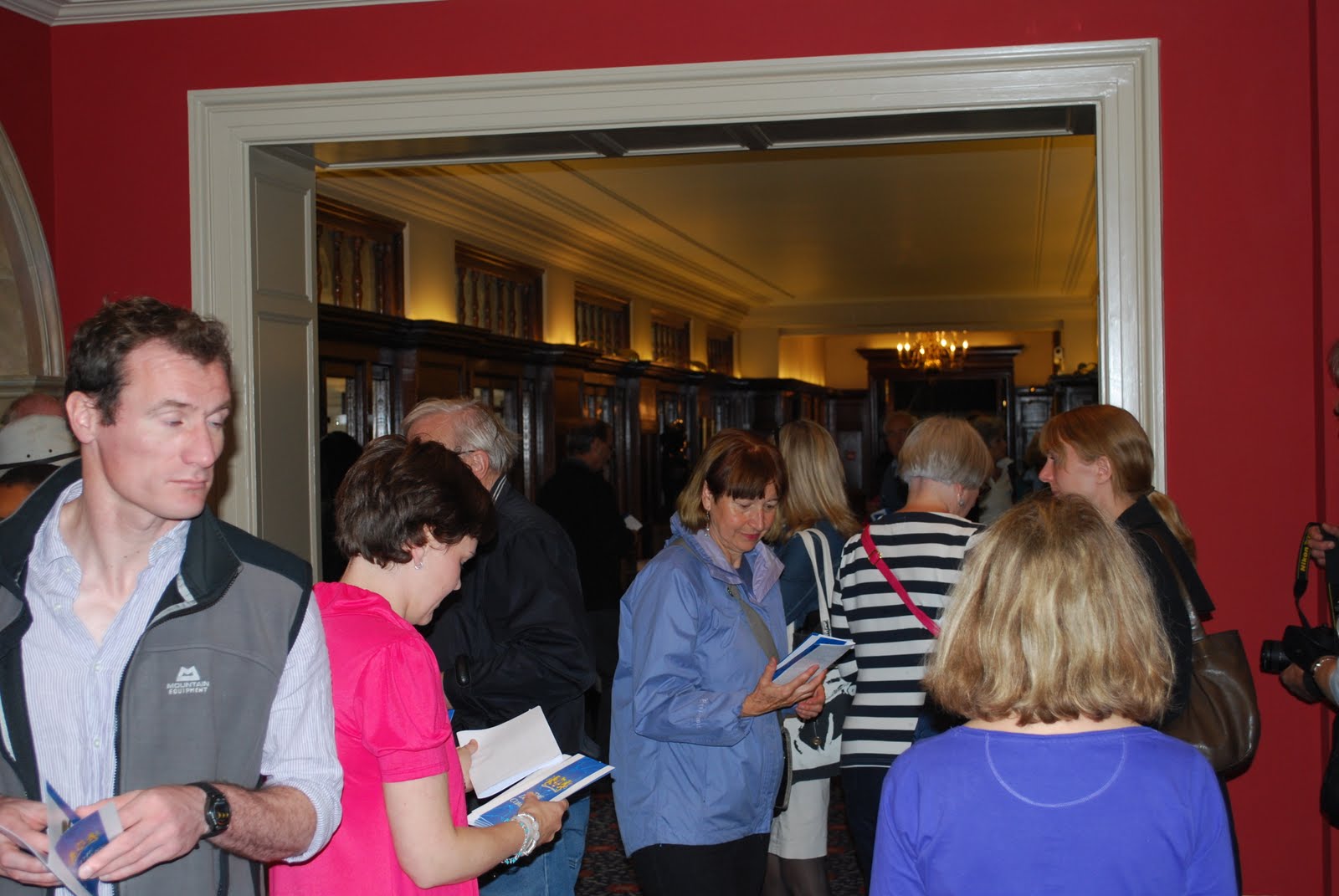
London Open House 2010, looking down the corridor into Throgmorton Street packed with visitors.
Yet again the Hall proved a very popular attraction.  Between 10.00am and 3.30pm over 1700 visitors thronged through the public rooms.  To many the Hall and its contents came as a completely unexpected discovery.  This is not surprising as the building is largely hidden behind offices and shops and the entrances to the Hall are very unobtrusive and give little indication of the sumptuously decorated public rooms hidden inside.  However a significant minority were extremely knowledgable and asked questions that required the encyclopaedic knowledge of our Archivist, Penny Fussell, to be fully deployed.

As last year members of the livery and freedom worked in shifts to act as guides who were not only in a position to answer any questions about the rooms - one or two admitted to a very sharp learning curve - but also to explain something about the Company.  Nearly thirty were involved and all remarked on what a worthwhile day it had been.  Without exception first-time visitors were bowled over by the rooms and those who knew about the Hall, however superficially, were keen to renew and deepen their knowledge of it.  Also it allowed those of us who use the Hall regularly to view it through new eyes and better appreciate our unique heritage.